

The aerospace industry in Mexico comprises companies that manufacture, maintain, repair, customize, engineer, design and provide auxiliary services (airlines, test laboratories, training centers, etc.) for commercial and military aircraft.
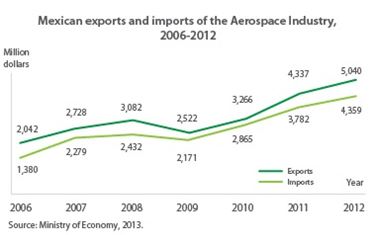
Mexico has consolidated its position as a global leader in the aerospace sector. The country's exports amounted 5 billion dollars in 2012, and recorded an annual average growth between 2006 and 2012 that exceeded 16%. Imports, meanwhile, topped 4.35 billion dollars, a positive trade balance for Mexico throughout 2012.
Strengths of the Aerospace Industry in Mexico

• Logistics. Due to its geographic location, Mexico is the meeting point of the world's two main aerospace manufacturing corridors, both in North America. The country’s access to the Asian and European markets make it the aerospace logistics and manufacturing center of the Americas.
• Experience. Mexico's success in the development of industries such as the automotive and the electric-electronic, provides an advanced manufacturing and infrastructure platform, which encourages the development of the aerospace industry in Mexico and optimizes supply chains, common support programs and synergistic advantages.
• Reliability. Mexico's export control system was placed under evaluation by the members of the Wassenaar Arrangement: Mexico was an exceptional case, being admitted in record time, even when no other new members had been approved in the previous five years. Mexico's admission shows the international community's interest in the country as a reliable destination for the integration of sensitive technologies. Reciprocally, acceptance into this prestigious group is proof of Mexico's commitment to remain a safe destination for the production of goods and services that include both restricted technologies and dual use goods and services.
• Competitive Costs. According to a study by KPMG, Mexico is 15.7% more cost competitive than the United States.
• Innovation. The large number of universities and research centers that focus on advanced manufacturing and materials encourage the development of innovation projects in the industry.
• Talent. According to estimates by Mexico’s National Council for Science and Technology, more than 111 thousand engineering and technology students graduated in Mexico in 2012. Based on numbers published by UNESCO in 2010, there are 18% more engineering, manufacturing and construction graduates per capita in Mexico than in the United States.
• Certified Quality. Mexico is one of the few countries with a Bilateral Aviation Safety Agreement (BASA) with the Federal Aviation Administration (FAA). Companies in Mexico have certified their processes to comply with industry standards such as ISO-9001, AS9100 and NADCAP
 Mexico's Aerospace Industry Road Map.
Relevant dataIn 2012, there were 270 companies and support entities for the aerospace industry, particularly in 6 states and they employ 32,000 high level professionals. |